If you've ever looked at an EC reading and wondered whether it was good, bad, or worth paying attention to, you're not alone.
Electrical Conductivity (EC) is one of the most useful measurements available from a soil probe, but it's often misunderstood.
Many people assume EC is simply a measure of nutrients. In reality, it's more accurate to think of EC as a measure of what's dissolved in the soil water around your plant roots.
When you combine EC with soil moisture and temperature data, it can help tell a much bigger story about what's happening beneath the surface.
First, what does EC actually measure?
EC stands for Electrical Conductivity.
Put simply, it measures how easily electricity can move through the soil water.
Pure water doesn't conduct electricity particularly well. However, when dissolved ions are present in the soil water, conductivity increases. Some of these ions come from nutrients, while others may come from naturally occurring salts in the soil.
That's why EC isn't a direct nutrient test.
Instead, it's an indicator that can provide useful clues about changes happening in the root zone.
Why looking at one number isn't enough
A common question is:
"What's a good EC reading?"
The challenge is that there isn't one ideal number.
EC can be influenced by:
- Soil type
- Soil moisture
- Temperature
- Fertiliser applications
- Irrigation
- Rainfall
- Naturally occurring salts in the soil
Also, the same EC can affect plants differently depending on species, so the same number can be good for a certain type of crop and bad for another. That's why a single reading rarely tells the full story. What's more useful is understanding how EC changes over time and what might be driving those changes.
Why the crop or pasture matters
One of the most important things to understand about EC is that different plants respond very differently to it.
A reading that has little impact on one species could be causing stress in another. That's why EC becomes much more useful when you combine the reading with the crop or pasture you're growing.
Most plants will grow normally up to a certain point. Once EC rises above that threshold, growth and yield can begin to decline.
The table below shows the approximate soil salinity levels (ECe) where production impacts can begin for a range of common pasture and crop species, and what that translates to in terms of sensitivity to EC levels.
| Plant/Crop | Approx. ECe Where Effects Begin (dS/m) | Sensitivity |
| White clover | ~1.0-1.2 | Sensitive |
| Sub clover | ~1.0-1.2 | Sensitive |
| Red clover | ~1.5 | Sensitive |
| Maize | ~1.7 | Moderately sensitive |
| Lucerne | ~2.0 | Moderately sensitive |
| Tall fescue | ~3.9 | Moderately tolerant |
| Perennial ryegrass | ~4.0+ | Moderately tolerant |
| Wheat | ~6.0 | Tolerant |
| Barley | ~8.0 | Very tolerant |
What this means in practice is that one part of a pasture may be affected before another.
Take a typical ryegrass and white clover dairy pasture. White clover can begin experiencing stress from elevated salinity levels well before ryegrass shows obvious signs of a problem.
Research has shown that white clover can start suffering production losses at EC levels where perennial ryegrass continues to perform well. In other words, a pasture may still look reasonably healthy from above, while rising EC is already reducing the clover content underneath.
This matters because clover contributes valuable feed quality and helps fix nitrogen naturally. If clover growth is being suppressed, overall pasture performance can suffer even when the ryegrass appears unaffected.
Another factor to keep in mind is plant age. Young plants are generally more sensitive to salinity than established plants. Germination and early establishment are often the most vulnerable stages, which means elevated EC levels can have a bigger impact on newly sown crops or pastures than on mature plants.
That's why there is no single "good" EC number. The reading needs to be considered alongside the crop or pasture being grown, the stage of growth, soil moisture conditions, and how the trend is changing over time.
What happens after fertiliser is applied?
One of the most common patterns growers observe is a rise in EC after fertiliser application.
As nutrients dissolve into the soil solution, the concentration of dissolved ions can increase, which often causes EC readings to rise.
You might see something like this:
- Fertiliser is applied.
- EC increases.
- Plants begin taking up nutrients.
- EC gradually changes again over time.
The exact pattern will vary depending on soil type, moisture conditions, fertiliser type, and weather.
The important point is that EC can help provide context around what's happening after an application.
What happens after rain?
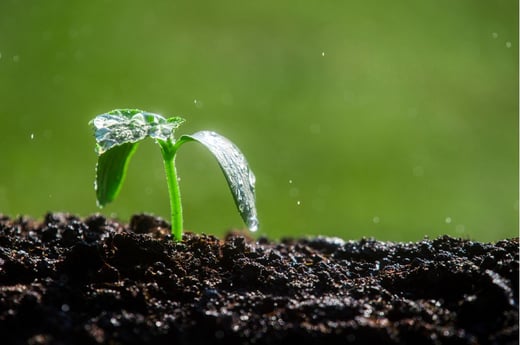
Rainfall often changes both soil moisture and EC readings.
As water moves through the soil profile, dissolved ions can be redistributed throughout the root zone. In some situations, nutrients and salts may move deeper into the profile along with the water.
This is why it's useful to look at EC and soil moisture together.
For example:
- Soil moisture increases after rainfall.
- EC changes across several depths.
- The pattern may suggest water is moving through the profile.
That doesn't tell you exactly which nutrients have moved or how much has moved. However, it can provide valuable clues about what's happening below ground.
Why depth matters
Conditions near the surface can be very different from conditions deeper in the root zone.
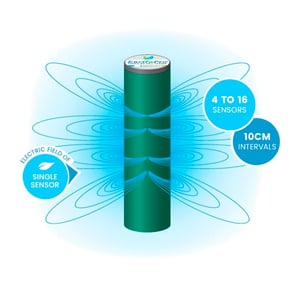 That's why Watermetrics' EnviroPro probes measure at 10 cm intervals throughout the soil profile, with options covering depths of 40 cm, 80 cm, 120 cm, and 160 cm.
Instead of seeing what's happening at a single point, you can see how moisture, temperature, and EC are changing through a much larger portion of the profile.
For example, you may be able to see:
- How deeply rainfall has penetrated.
- Whether irrigation is reaching the desired depth.
- Where water is accumulating.
- Whether moisture is moving beyond the active root zone.
- How conditions differ between shallow and deeper soil layers.
Those insights are often more valuable than any single EC reading.
Why temperature matters too
Soil temperature influences plant growth, root activity, and biological processes occurring in the soil.
Because EnviroPro probes measure temperature alongside moisture in all models, growers can better understand how seasonal conditions are affecting the root zone.
Looking at moisture, temperature, and EC together provides a more complete picture than any single measurement on its own.
Focus on trends, not individual readings
The most successful users don't spend their time asking:
"Is this EC reading good or bad?"
Instead, they ask:
- What is normal for this paddock?
- How did EC respond after rainfall?
- What happened after irrigation?
- How did the profile respond after fertiliser was applied?
- Are conditions changing differently at different depths?
- Could rising EC be affecting sensitive species in my pasture or crop?
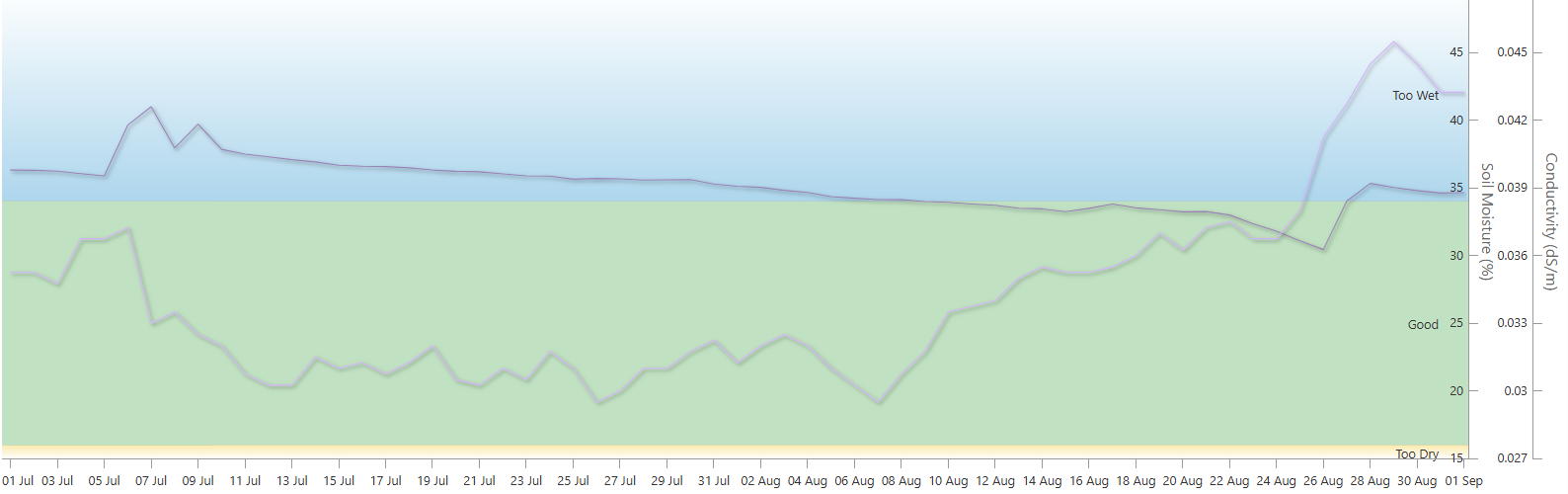
Over time, those trends help build a clearer understanding of how water is moving through the soil and how the root zone is responding.
Better visibility leads to better decisions
The real value of EC isn't the number itself.
It's understanding what that number means for the plants you're growing.
When combined with soil moisture and temperature data, EC provides valuable context about what's happening in the root zone and how conditions are changing over time.
Watermetrics' Soil Moisture Analytics platform brings these measurements together, helping growers understand how conditions are changing throughout the profile and supporting more informed decisions around irrigation, fertiliser timing, and seasonal management.
Ready to make more informed decisions this season?
Every farm is different. That's why the best monitoring solution is one that's matched to your soils, water challenges, and management goals.
Whether you're looking to improve irrigation efficiency, better understand soil moisture, monitor water use, or gain greater visibility into what's happening below the surface, the Watermetrics team can help.
Talk to one of our experts today to discuss your farm's specific needs and find the right solution for your operation.